

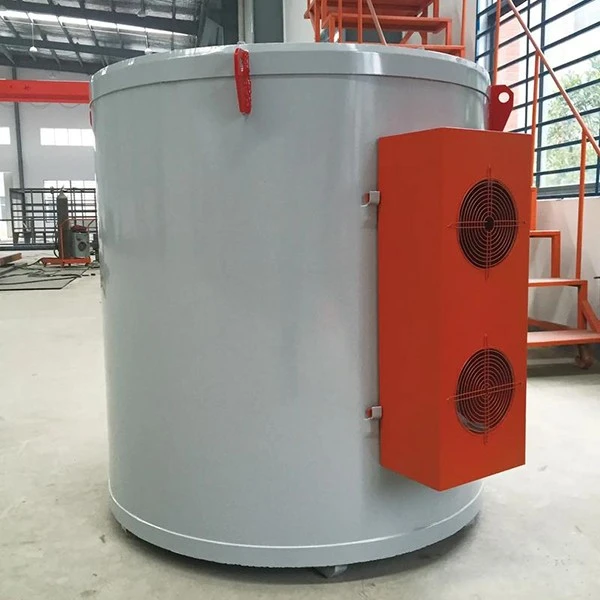
Well Normalizing Furnace
What do you use it for? Normalizing and annealing. Long shafts, big forgings, heavy machinery parts that would bend if you laid them down flat. The vertical orientation keeps them straight. Plus you get even heating and stress relief without distortion.
Danyang Dingfeng Industrial Furnace Co., Ltd. is one of the most reliable manufacturers and suppliers of well normalizing furnace in China. If you're going to wholesale durable well normalizing furnace made in China, welcome to get pricelist from our factory. All customized products are with high quality and low price.
Product Definition
Well normalizing furnace is a vertical batch furnace – goes in the ground. The chamber is deep and cylindrical. You load parts vertically. That's the whole point.
What do you use it for? Normalizing and annealing. Long shafts, big forgings, heavy machinery parts that would bend if you laid them down flat. The vertical orientation keeps them straight. Plus you get even heating and stress relief without distortion.

Working Principle
You hang the workpieces from a fixture. Overhead crane picks them up, lowers them into the pit. Straight down.
Close the heavy lid. Seal it.
The heating system kicks on. There's a circulation fan inside – big one, high temperature rated. It moves air down and around. That's the "composite airflow" people talk about. Basically the air goes down the center, hits the bottom, comes back up the sides. Moves heat to every part of the workpiece.
You hold the parts at the austenitizing temperature for whatever soak time your material needs. For normalizing, you don't quench. You let them cool in air. Controlled cooling. That refines the grain and gets rid of internal stress.

Features
Handles long heavy parts without bending
- Even heating. The chamber layout plus the circulation system gives you uniform temperature.
- Precise control. PLC or PID systems. Holds temperature steady. You can program your cycle and let it run.
- Big capacity. These things handle large loads.
- Energy efficient. Ceramic fiber or refractory brick – depends on your cycle. Fiber saves power if you cycle on and off. Brick is fine for continuous operation. The lid seal matters too. If your lid leaks, you lose a lot of heat up the top.
- Natural cooling. For normalizing, you don't need forced cooling. Just let it sit in air. The well design keeps the cooling uniform because there's no draft.
- Durable structure. Heavy steel liner, heat resistant lining.
- Customizable. Depth, diameter, temperature range, heating method, automation – all changeable. No two wells are exactly the same.
Applications
Heavy machinery
Machine tool beds, heavy castings, forged blanks.
Wind power and energy
Long wind turbine main shafts, big flanges.
Automotive and forging
Crankshaft blanks, connecting rods, gear pre-forms. Refine the grain before final machining.
Oil and gas
Long drill pipes, casings, large valves.
Railway and transportation
Axles, railway tracks, other long structural parts.
Equipment Structure
Let me walk you through the parts of Well normalizing furnaces.
- Furnace pit body. Vertical chamber below ground. Heavy steel liner – 10 to 20mm thick depending on size. Lined with insulation. The pit sits in a concrete sleeve. You need good drainage at the bottom, otherwise water pools and rusts the liner.
- Heating system. Electric or gas. Electric uses resistance elements mounted on the walls. Gas uses burners firing into radiant tubes or directly into the chamber. For normalizing, electric is more common because you don't need super fast heat-up.
- Furnace cover. Lifting lid. Insulated – same as the walls. The cover seals against the top of the pit. We use a sand seal or a soft fiber rope. The cover is heavy. You need a hoist just for the lid. Sometimes a separate hoist, sometimes the same crane that loads parts.
- Loading system. Overhead crane or electric hoist. The fixture hangs from the crane hook. Fixture design matters – it has to hold the parts securely and not sag at temperature. We use 310 stainless or Inconel for the fixtures, depending on temperature.
- Temperature control system. PL
- C or PID. You can program multiple recipes. The controller reads thermocouples at different depths. I usually put one thermocouple every meter. That gives you a temperature profile.
- Hot air circulation system. One big fan at the top or bottom. Usually top, blowing down. The air hits the bottom and comes back up around the sides. Without this fan, forget about uniformity. The fan runs continuously during the soak. Fan motor is outside the furnace – shaft goes through the lid with a seal.
- Insulation layer. Ceramic fiber or refractory brick. Fiber heats up fast, good for job shops that cycle once a day. Brick holds heat, good for continuous operation. I've done both. Fiber is more common now because energy costs are high.
- Safety protection system. Over-temperature alarm – independent thermocouple that shuts everything down if it gets too hot. Lifting interlocks – you can't open the lid while the fan is running. Emergency stop buttons. Leakage protection on the electrical side. Standard stuff but important.
Hot Tags: well normalizing furnace, China well normalizing furnace suppliers, factory, All fiber Lined Well Furnace, Pit Type Annealing Furnace, Vacuum Well Furnace, well furnace, Well type Aging Furnace, Well type Quenching Furnace


Send Inquiry
