1. Vacuum Furnace Types and Process Configurations
| Furnace Type |
Primary Process and Heating Configuration |
| Vacuum Quenching Furnace |
Electric resistance heating; graphite heating elements for high-temperature models. |
| Vacuum Tempering Furnace |
Tempering under vacuum or inert gas, with natural or forced gas cooling options. |
| Vacuum Sintering Furnace |
Resistance, induction, or microwave heating. |
| Vacuum Melting Furnace |
Medium-frequency power supply and induction coil. |
2. Vacuum Quenching Furnace
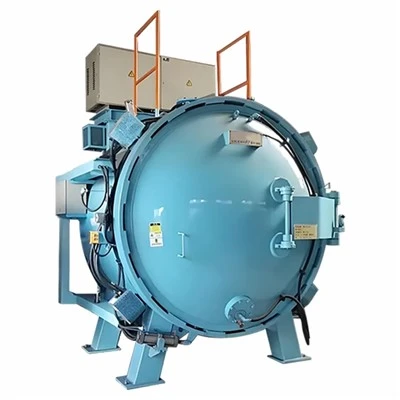
Our vacuum quenching furnace uses electric resistance heating. High-temperature models use graphite heating elements.
Cooling configurations include:
- High-pressure nitrogen or argon gas quenching.
- Vacuum oil quenching on selected configurations.
- Gas circulation cooling.
The furnace also features multi-zone heating. The published temperature deviation is ±3°C; the measurement conditions and test standard are not specified.
PLC automatic control is provided, with safety interlocks, over-temperature alarms, pressure interlocks, and cooling-water protection.
3. Vacuum Tempering Furnace
Our vacuum tempering furnace supports tempering under vacuum or inert gas. Cooling can take place under vacuum or inert gas, with natural or forced gas cooling.
Configuration features include:
- High-flow circulation fan.
- Optimized airflow duct.
- Custom fixtures.
- Optional process data recording.
- PLC control and real-time monitoring.
4. Vacuum Sintering Furnace
Vacuum sintering heating options include:
- Resistance heating.
- Induction heating, with power-frequency, medium-frequency, and high-frequency configurations.
- Microwave heating.
One documented configuration evacuates the chamber, backfills it with hydrogen, and uses induction heating with a tungsten crucible. This is a specific process arrangement, not a standard configuration for every vacuum sintering furnace.
5. Vacuum Melting Furnace
Our vacuum melting furnace uses a medium-frequency power supply and induction coil.
Configuration features include:
- Secondary charging port.
- Observation window.
- Sampling system.
For high-manganese or high-aluminum alloy applications, the published process information specifies a vacuum range of 10–100 Pa, or evacuation followed by argon backfilling. This range is specific to the described applications and should not be treated as a general specification for all vacuum melting furnaces.
6. Manufacturing and Technical Support
As a China-based vacuum furnace manufacturer, we design and manufacture industrial electric furnaces, including vacuum furnaces, annealing furnaces, pit furnaces, bogie hearth furnaces, and carburizing furnaces.
7. Request a Vacuum Furnace Quotation
Send us your target process, material, workpiece dimensions, required batch weight, operating temperature, and vacuum requirements.
You can also start with an existing equipment specification, workpiece photograph, or estimated order quantity. We will review the information and discuss the applicable vacuum furnace type and configuration for your project.