

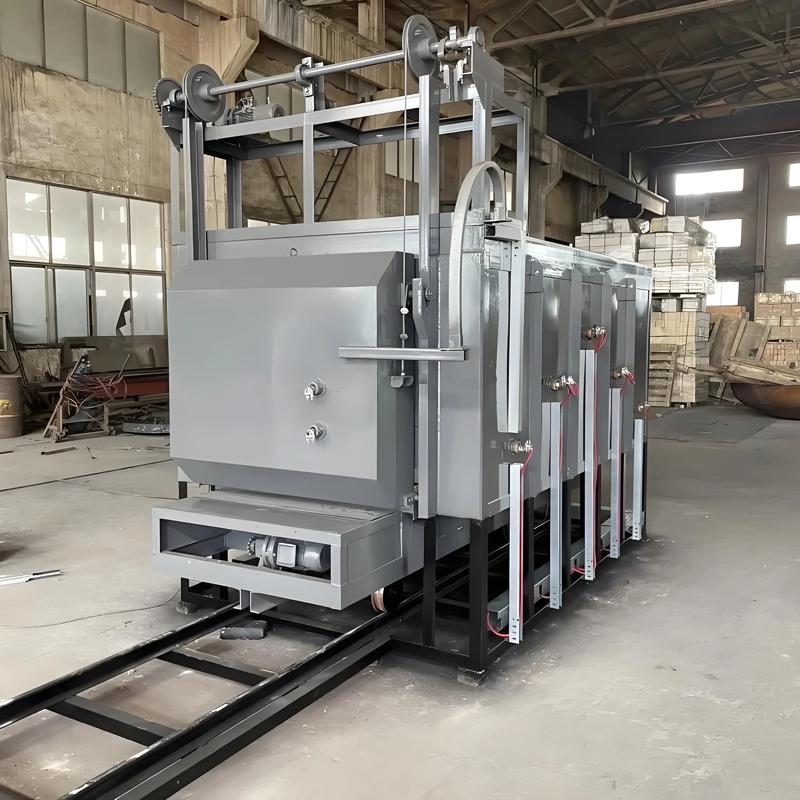
Horizontal Quench Furnace
The Horizontal quench furnace – the chamber sits flat, not standing up. You heat your parts, then quench them. Oil, water, gas – whatever medium you need.
Why horizontal? Some parts just won't work in a vertical furnace. Long shafts. Weird shapes. Things that are five meters long and flop over if you try to stand them on end. Horizontal fixes that.
Danyang Dingfeng Industrial Furnace Co., Ltd. is one of the most reliable manufacturers and suppliers of horizontal quench furnace in China. If you're going to wholesale durable horizontal quench furnace made in China, welcome to get pricelist from our factory. All customized products are with high quality and low price.
Product Definition
The Horizontal quench furnace – the chamber sits flat, not standing up. You heat your parts, then quench them. Oil, water, gas – whatever medium you need.
Why horizontal? Some parts just won't work in a vertical furnace. Long shafts. Weird shapes. Things that are five meters long and flop over if you try to stand them on end. Horizontal fixes that.

Working Principle
Let me explain how this thing runs.
The Horizontal quench furnace is laid out flat – obviously. Parts go in from one end. Track or conveyor belt, depends how you set it up. They move through three zones: heat, hold, quench. In that order.
Heat zone brings the temperature up. Hold zone soaks the parts – gives the heat time to get all the way through the thick sections. Then quench zone cools them fast.
The horizontal layout gives you better temperature distribution along the length. I've run tests on both vertical and horizontal with three meter long shafts. Vertical had a 15°C difference from top to bottom.
Horizontal had about 5°C from end to end. That makes a real difference when you're hardening tool steel.

Features
Handles long parts
This is why people buy these things. Shafts from one meter up to five meters – no problem. Irregular shapes that would tip over in a vertical basket? Fine. We had a customer with turbine shafts – 4.2 meters long, 300 kg each. They tried vertical first. The shafts wobbled when the basket lifted. Switched to horizontal. No more wobble.
Better efficiency
Full fiber lining. The control system is just PID with some logic – nothing magical. But here's a real number: we tested a 2.5 meter horizontal against a comparable vertical unit. Same load, same temperature, same cycle time. Horizontal used about 15% less power. Why? Heat rises. In a vertical furnace, the top gets hotter than the bottom. You have to overheat the top to get the bottom to temperature. Horizontal doesn't have that problem. That 15% came from actual shop floor tests, not a brochure.
Safer to operate
Horizontal means you load and unload at waist height. Not reaching up into a hot vertical chamber. Not pulling baskets out from overhead. One customer told me they had three burn incidents with their old vertical furnace – guys getting their arms cooked. Switched to horizontal, zero burns in four years. Good door sealing also helps – less heat escaping means less radiant heat on the operator.
Applications
Automotive
Shaft parts – drive shafts, half shafts. A customer runs 4340 steel axle shafts, 1.8 meters long. Their cycle: heat to 850°C, hold 90 minutes, quench in oil at 60°C. Torsional strength went from 800 MPa to 1150 MPa after heat treatment. They cut warranty claims by half.
Aerospace
Turbine blades, engine blocks. One shop runs Inconel 718 turbine blades – small parts, but the shape is weird. Won't stack well in a vertical basket. They use a horizontal furnace with a mesh belt. 980°C solution treatment, hold 60 minutes, gas quench. Temperature uniformity across the belt is ±4°C. They certify every batch.
Mold processing
Cold work die steel – D2, O1, A2. A mold maker in Ohio runs D2 punches and dies. Their horizontal cycle: heat to 980°C at 10°C per minute, hold 45 minutes, quench in nitrogen. They get HRC 54-56 consistently. Before they switched to horizontal, they had a vertical furnace. Hardness varied from 50 to 58 on the same load – temperature gradient killed them. Their mold life went up about 30% after the switch. They tracked it for two years.
Customization Capabilities
Dingfeng Industrial Furnace – we change things based on what you need. I don't like saying "customization capabilities" but that's what people search for.
Door speed. We can size the motor and reducer for faster opening if you're running high production. Standard door speed is about 3 meters per minute. For a customer doing 50 batches a day, we put in a 5 m/min drive. Shaves off maybe 30 seconds per cycle. Doesn't sound like much, but over a year that's 150 hours.
Door type. Standard is a single piece door that lifts straight up. But if your ceiling is low, you can't do that. We've built split doors – top half lifts, bottom half swings sideways. Works fine. More maintenance because there are more moving parts. One customer had a 2.4 meter ceiling. We did the split design. Tight fit but it worked.
Automation. We can wire the furnace into a PLC line. Central control, remote operation, data logging. Some customers want it. Some don't. I've got one shop that runs everything off a touchscreen. Another shop – the guy still uses a chart recorder from 1985. Both work.
Observation ports. Heat resistant glass peepholes in the door. Internal light if you want to see what's happening. One customer uses them to check when their parts start to glow. They do a visual on every batch – look for color uniformity. If one end of a shaft is darker, they know they have a heating problem. Saved them from scrapping parts more than once.

Hot Tags: horizontal quench furnace, China horizontal quench furnace suppliers, factory


Send Inquiry
