

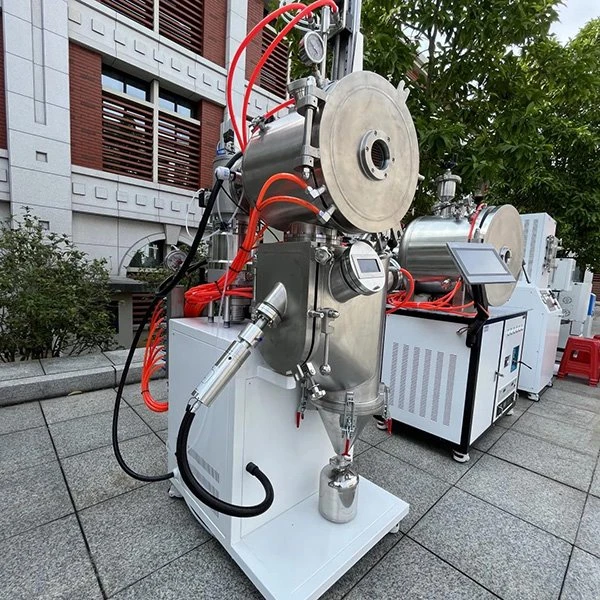

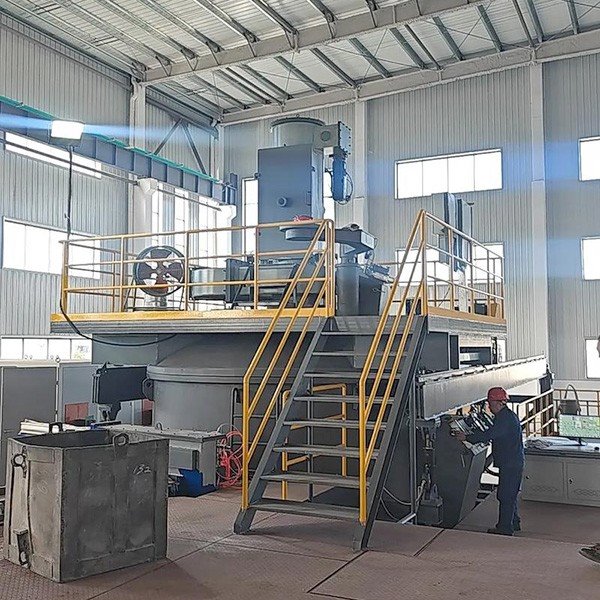
Vacuum Melting Furnace
The unit runs on medium frequency power. Heats up fast, holds temperature well, saves electricity. Comes with a secondary charging port, observation window, and sampling system. These aren't just for show – secondary charging lets you add volatile elements like aluminum or titanium in the middle of the melt, before they evaporate.
Danyang Dingfeng Industrial Furnace Co., Ltd. is one of the most reliable manufacturers and suppliers of vacuum melting furnace in China. If you're going to wholesale durable vacuum melting furnace made in China, welcome to get pricelist from our factory. All customized products are with high quality and low price.
Product Definition
Vacuum melting furnaces can melt metals and alloys.People making superalloys, specialty steels, and non-ferrous metals use these.
The unit runs on medium frequency power. Heats up fast, holds temperature well, saves electricity. Comes with a secondary charging port, observation window, and sampling system. These aren't just for show – secondary charging lets you add volatile elements like aluminum or titanium in the middle of the melt, before they evaporate.
Vacuum lowers gas pressure and improves metallurgical reaction conditions. For reactions where the number of gas product moles is higher than the reactant side, pulling vacuum drives the reaction to the right. Think decarburization, deoxidation, degassing – all much more efficient under vacuum.

Working Principle
Vacuum induction melting: electromagnetic induction heats the metal under vacuum.
Medium frequency current goes through the induction coil. That creates an alternating magnetic field. The metal inside gets eddy currents, heats itself up, and melts.
The vacuum system pulls air out of the chamber. The metal melts in a low pressure environment – no oxidation, no contamination.
In practice, you don't always want the highest vacuum. Too much vacuum, and volatile elements evaporate. For high manganese or high aluminum alloys, we hold vacuum between 10 and 100 Pascals, or backfill with argon after pulling vacuum.

Features
- High purity. Vacuum removes oxygen and moisture. No oxidation, no contamination. Gas content drops. Fatigue strength and structural stability improve. One superalloy plant measured oxygen drop from 150 ppm to 15 ppm after vacuum melting. Fatigue life tripled.
- Good alloy quality. Uniform composition, stable mechanical properties. But watch out – some elements evaporate under vacuum. Magnesium goes fast. Magnesium alloys usually melt under protective atmosphere or get their magnesium added late.
- Steady temperature. The control system works with the medium frequency power supply. Usually within plus or minus 5 degrees. For precision alloys, that's enough.
- Low gas content. Vacuum pulls out hydrogen, nitrogen, oxygen. For aerospace grade material, this is non-negotiable.
- Clean and safe. No smoke, no fumes. Clean shop floor. Environmental inspections go easier.
- Automated. PLC programmable, real time monitoring, data logging. Process control is tight. Traceability is there.
Applications
Vacuum melting furnaces go into superalloys, precision alloys, specialty steels, non-ferrous metals, and magnetic materials.
Typical parts:
- Aerospace. Turbine disks and blades – Inconel 718, Rene 41, CMSX single crystal alloys. All melted under vacuum.
- Specialty steels. Bearing steel, tool steel, stainless. Need low oxygen, low sulfur, low inclusion counts.
Hot Tags: vacuum melting furnace, China vacuum melting furnace suppliers, factory, vacuum furnace, Vacuum Melting Furnace, Vacuum Quenching Furnace, Vacuum Sintering Furnace, Vacuum Tempering Furnace


Send Inquiry
